
Validate e-mail (Digital)
Validate Email
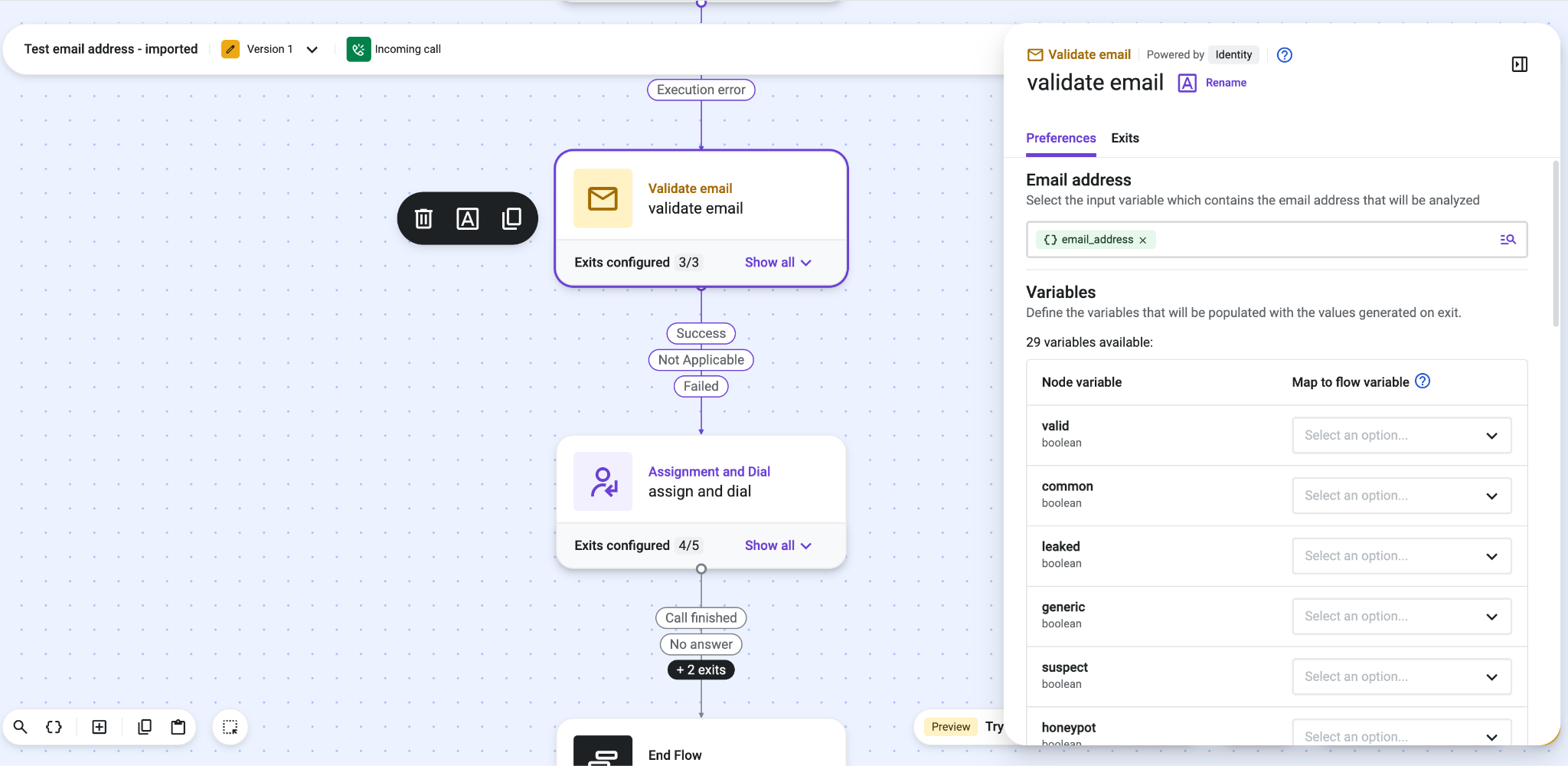
The Validate Email component ensures that the caller's email address is verified against any fraudulent activity. This component is available for digital incoming flows, specifically for email.
Preferences
Email address
Configure the variable containing the Email address to be analyzed. Usually, the variable containing the incoming email address is used as the input variable, but any other variable that contains an email address can be used.
The source_Email variable can be defined for digital channels in the initial step of the flow.
Variables
The variables shown below can be used to route interactions in Studio. You can use them to fill in the relevant Variables fields, or expose them to agents in the Conversations app context panel.
| Validation Insight | Description | Value Type | Value Ranges |
|---|---|---|---|
| valid | Indicates whether the email address appears to be valid. | Boolean | true, false |
| disposable | Identifies whether the email belongs to a temporary or disposable mail service, which is commonly associated with fraudulent activity. | Boolean | true, false |
| timed_out | Indicates whether the email verification connection to the mail service provider timed out during the check. | Boolean | true, false |
| deliverability | Reflects the likelihood that an email sent to this address will be successfully delivered and land in the recipient's mailbox. | String | high, medium, low |
| catch_all | Indicates whether the email address belongs to a catch-all mail server, where all emails sent to the domain are accepted regardless of whether the specific address exists. | Boolean | true, false |
| leaked | Indicates whether the email address has appeared in a known third-party database breach. Leaked addresses carry an elevated risk of compromise. | Boolean | true, false |
| suspect | Indicates whether the mail server is returning a temporary error or is otherwise unable to complete the verification of the address. | Boolean | true, false |
| smtp_score | Represents the validity of the email server's SMTP configuration. | Integer | -1, 0, 1, 2, 3 |
| overall_score | Represents the overall validity of the email address. | Integer | 0, 1, 2, 3, 4 |
| first_name | Contains the suspected first name associated with the email address. Returns CORPORATE for generic business addresses and UNKNOWN when no name can be determined. | String | Name, CORPORATE, UNKNOWN |
| common | Indicates whether the email address belongs to a widely used free email provider. | Boolean | true, false |
| generic | Indicates whether the email address appears to be a shared or role-based address for a domain, such as admin@, webmaster@, or newsletter@. | Boolean | true, false |
| dns_valid | Indicates whether the email address's domain has valid DNS records, providing a partial signal of address validity. | Boolean | true, false |
| honeypot | Indicates whether the email address is believed to be a spam trap or honeypot. Sending to these addresses may increase the risk of being blacklisted by major ISPs. | Boolean | true, false |
| spam_trap_score | Reflects the confidence level that the email address is an active spam trap. Addresses with a high score are recommended for removal from promotional mailing lists. | String | high, medium, low, none |
| recent_abuse | Indicates whether the email address has been associated with recent verified abuse on the network, such as chargebacks, fake signups, or other malicious activity. | Boolean | true, false |
| fraud_score | Represents the overall fraud risk of the email address based on its reputation and recent behavior. Scores of 75 or above are considered suspicious; scores of 85 or above are considered high-risk. | Float | 0–100 |
| frequent_complainer | Indicates whether the email address has a history of unsubscribing from marketing communications or submitting spam complaints. | Boolean | true, false |
| suggested_domain | Provides a corrected domain suggestion when the email address appears to contain a typo (for example, gmai.com corrected to gmail.com). Returns N/A when no correction is needed. | String | Domain name, N/A |
| domain_velocity | Reflects the volume of legitimate user activity associated with the email address's domain. Newer or rarely visited domains receive a value of none. | String | high, medium, low, none |
| domain_trust | Represents the risk classification of the email's domain, derived from historical abuse patterns and positive behavior signals. | String | trusted, positive, neutral, suspicious, malicious, not rated |
| risky_tld | Indicates whether the email address uses a top-level domain that is frequently associated with malware, phishing, scams, or other abusive activity. | Boolean | true, false |
| spf_record | Indicates whether the email's domain has a valid SPF DNS record configured. | Boolean | true, false |
| dmarc_record | Indicates whether the email's domain has a valid DMARC DNS record configured. | Boolean | true, false |
| sanitized_email | Contains a cleaned version of the email address with all aliases and masking removed, such as duplicate periods used in Gmail addresses. | String | Email address |
| first_seen | Contains information about when the email address was first observed by the system, including a human-readable description, a Unix timestamp, and an ISO 8601 formatted date. | Object | human, timestamp, iso |
| domain_age | Contains information about when the email address's domain was first registered, including a human-readable description, a Unix timestamp, and an ISO 8601 formatted date. | Object | human, timestamp, iso |
| identity_data | An enterprise-level data point containing enhanced identity enrichment sourced from authoritative sources such as credit bureaus, telcos, and utility companies. Includes associated names, addresses, phone numbers, and age information. Each entry represents one person and each field may return multiple values. Returns null or an empty array when data is unavailable. | Object | names, addresses, email_addresses, phone_numbers, age |
| mx_records | Lists the MX records associated with the email address domain name. | Array | Record values |
| a_records | Lists the A records associated with the email address domain name. | Array | Record values |
| result_type | Describes how the system produced the result. | String | cached, fast, live |
| request_id | A unique identifier for the validation request, which can be used to look up request details or send a postback conversion notice. | String | UUID |
smtp_score Values
-1= Invalid email address0= Mail server exists, but is rejecting all mail1= Mail server exists, but is showing a temporary error2= Mail server exists, but accepts all email3= Mail server exists and has verified the email address
overall_score Values
0= Invalid email address1= DNS valid, unreachable mail server2= DNS valid, temporary mail rejection error3= DNS valid, accepts all mail4= DNS valid, verified email exists
Exits
Success
Configure the component that contacts are redirected to when email validation is completed successfully.
Not Applicable
Configure the component that contacts are redirected to when there is no email address available to validate.
Examples include:
- Email interactions without an address
- Webchat interactions
Error Handling
Use the Error Handling section to define the behavior for unexpected failures during component execution.
For more information, refer to the Error Handling documentation.